
The Rent vs Own Decision For Retirement (New Zealand)
Let’s talk about spending - because that’s the real topic of discussion underneath the rent vs own debate in Retirement.
Most people picture retirement planning as “how much do I need?” but the practical version is simpler. It’s:
“How do I convert the savings I’ve built into a stable, livable weekly lifestyle for as long as I’m alive?”
A common ideal should then be to spend confidently throughout retirement and arrive at the end having used up every single dollar for its purpose. Not to die with the biggest balance, but to match money to life.
So in this post, we’re going to model the same retiree under a few housing systems:
Rent and invest the $1,000,000
Buy a home and live off what’s left
Move into a retirement village and live off what’s left
The assumptions in this case study
A single person retiring at 65
They’ve sold their previous home and are entering retirement with $1,000,000
Investments are held in a balanced portfolio
NZ Super is included as retirement income ($28,000 per year / $538 per week)
Costs rise with inflation in the background at 3% per year (unless stated otherwise)
Important: these are projections, not promises. The value is derived from seeing what drives outcomes.
Rent A Home ($530 per Week)
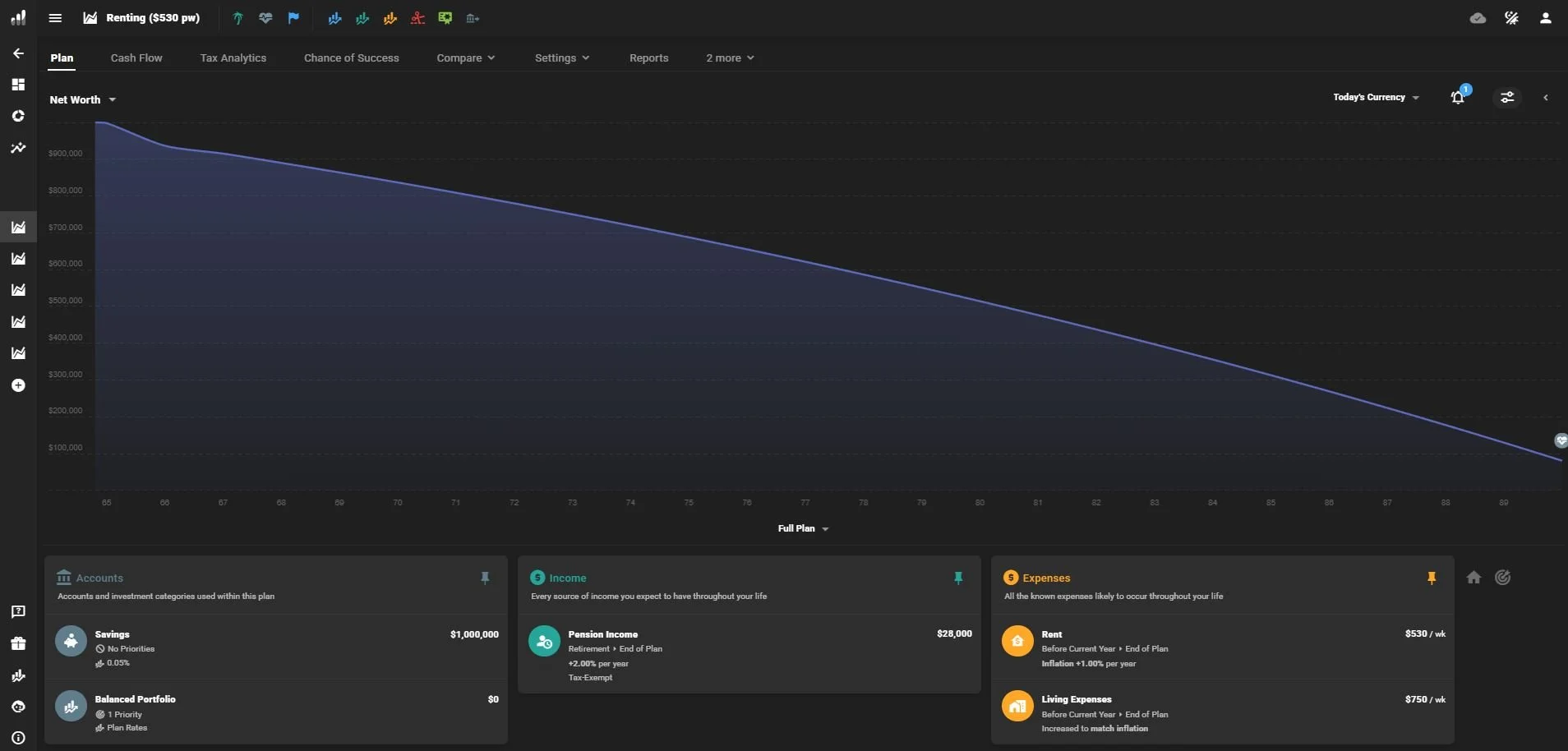
This projection models a retiree starting with $1,000,000 invested in a balanced portfolio, renting at $530 per week and spending $750 per week on living costs (in today’s dollars). To add a buffer of safety we are projecting rent rises at 4% per year (CPI + 1%) - which is faster than the norm of 2%-3% per year.
In this scenario, the retiree keeps the full $1,000,000 invested and rents a home at $530 per week.
They then draw additional spending for living costs - food, transport, health, power, hobbies, and day-to-day life - at $750 per week.
What this chart is really showing is the cost of keeping housing as a permanent line item.
When you rent in retirement, you are choosing to fund housing from the portfolio every year, forever. That creates two pressures:
Your withdrawals are higher
Higher withdrawals mean the portfolio has less time to compound - and you’re more exposed to poor returns early on.You’re exposed to rent inflation
Even if inflation is “normal”, rent can move faster than the general CPI basket. A plan that works at $530 per week can stop working if rent resets upward.
The upside of renting is flexibility and liquidity:
You keep your capital invested
You can move suburbs, cities, or downsize easily
You don’t have homeowner maintenance surprises
The downside is that you never actually solve housing. You simply keep paying for it.
Key risks of renting:
Rent increases faster than modelled, especially during tight rental markets
You may have to move multiple times in retirement due to landlord decisions, sale of property, or tenancy changes
Longer life expectancy increases the chance you face a difficult period of markets and rent increases at the same time
Health changes can force a move into more suitable housing that costs more
Rent A Home ($650 per Week)
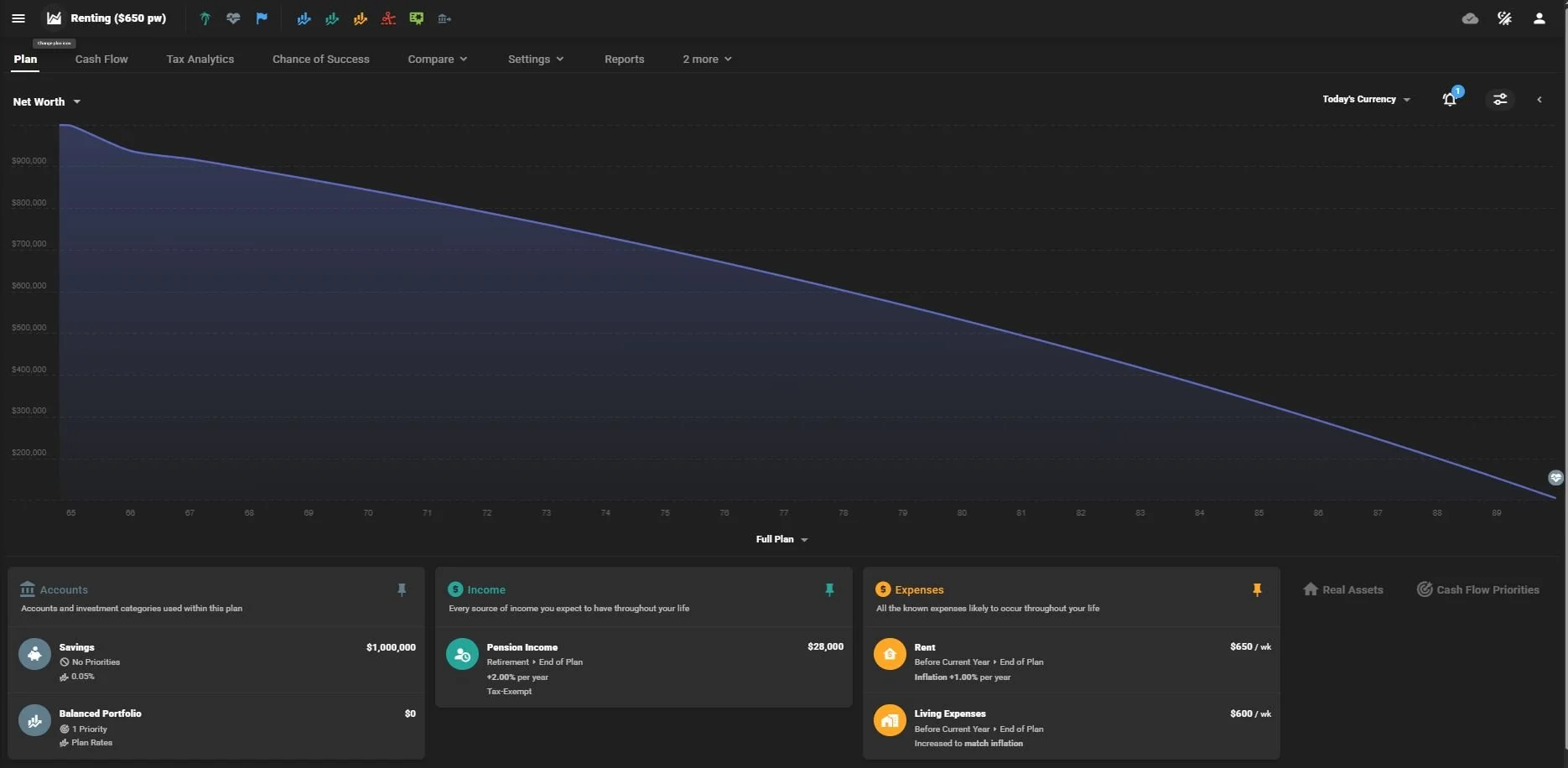
Same setup - $1,000,000 invested in a balanced portfolio - but rent increases to $650 per week. To keep the plan workable, living expenses are reduced to $600 per week, highlighting the real trade off: higher rent doesn’t just reduce the ending balance - it reduces lifestyle, year after year. In this projection we’re assuming rent rises materially faster than long term expectations of 3% per year.
And this is the key lesson:
Higher rent doesn’t just cost you more, it reduces standard of living.
Most retirees experience higher rent as:
fewer holidays
less buffer for health
delaying dental
driving the same car longer
saying no to hobbies and social spending
Rent is a lifestyle lever. And in retirement, lifestyle levers matter more than the net worth number.
Key risks of renting at higher levels
The plan becomes more fragile - there is less “fat” in the budget for lifestyle spending
If health costs rise, there is nowhere easy to cut without reducing quality of life
Buy A Home ($800,000) & Live Off The Rest ($200,000)
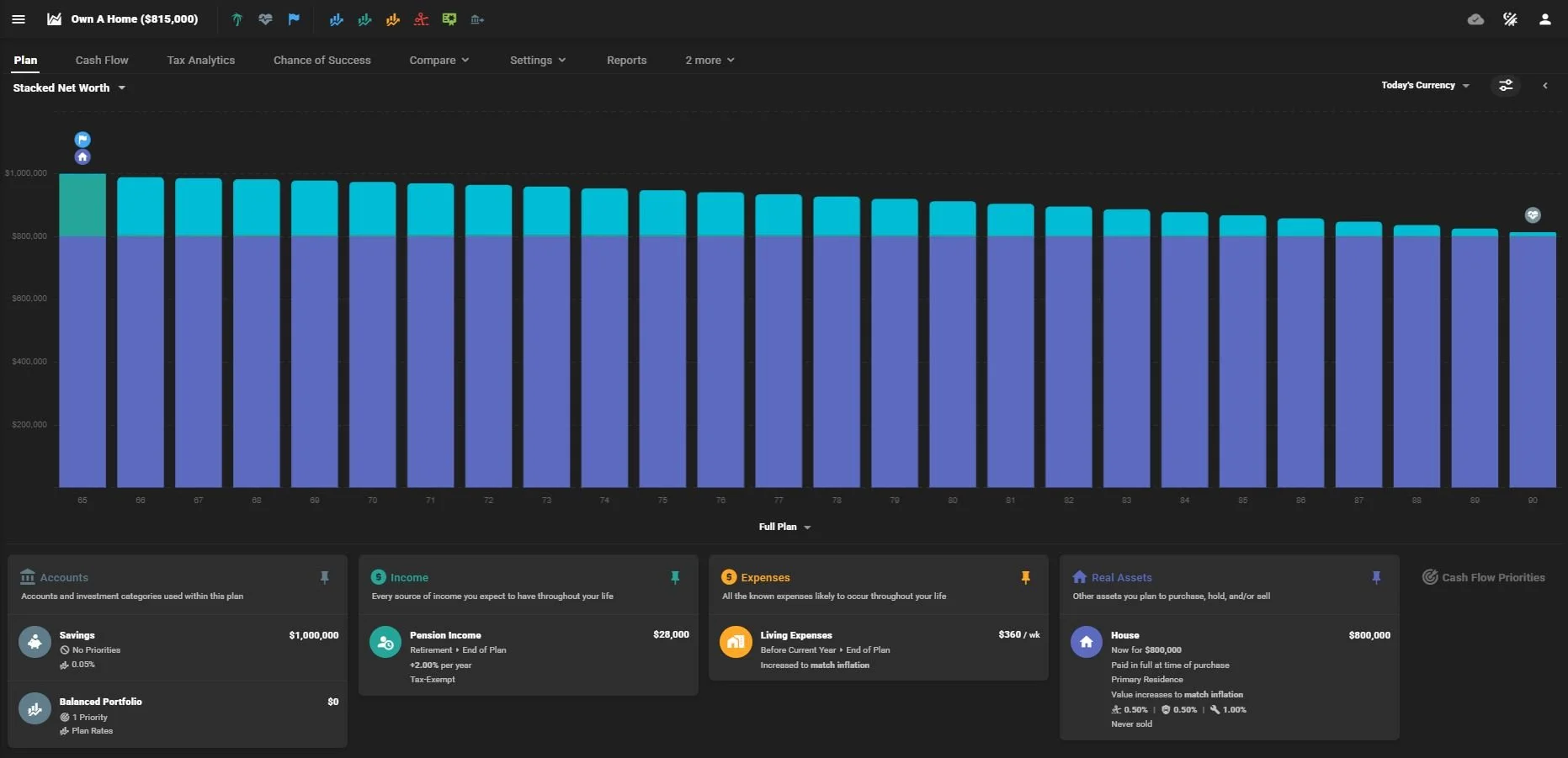
This scenario allocates $800,000 to a home purchase, leaving $200,000 invested to fund retirement spending. The chart looks stable because most wealth is now tied up in the house - but the key constraint becomes liquidity (in other words, you can’t eat the house): you still need to cover rates, insurance, maintenance, and day-to-day living from a much smaller investment pool.
This scenario is where most people feel emotionally safe - because owning a home feels like security.
And to be fair, it is a form of security.
But it changes what your $1,000,000 actually is.
Instead of $1,000,000 invested and liquid, you now have:
About $800,000 tied up in home equity
About $200,000 left invested to fund your lifestyle
This is where many retirees get surprised.
A home does not generate cashflow. It reduces one line item (rent), but introduces new ones:
Rates
Insurance
Maintenance and repairs
Long-term capital expenses (roof, repainting, appliances, bathrooms, fencing, drainage, damp)
In this example, we include:
$8,000 per year maintenance
$2,000 per year insurance
$4,000 per year rates
That’s $14,000 per year of “housing costs” that still exist, even when you own.
So the risk is not that owning is bad.
The risk is liquidity.
Net worth can look great on paper, but net worth doesn’t pay the grocery bill. Cashflow does.
If the remaining investments are only $200,000, your weekly spending ability becomes very tight (less than NZ Super yields) - because you’re asking a small pool of money to fund all living costs, for decades, while still absorbing homeowner costs.
This is where people end up on the peas and beans diet.
Key risks (Owning a higher-value home)
Asset rich, cash poor: a high net worth but limited liquid funds to live off
Maintenance is lumpy, not smooth - skipping it creates bigger bills later
Rates and insurance can rise faster than inflation
If health declines, you may need to pay for support and care while still holding an expensive property
The plan can force a late-life sale, which is emotionally and practically harder in your 80s
A quick counterpoint to consider:
It is possible to ‘eat the house’ using a reverse equity mortgage via a specialist lender (contact us for details), however, this lending usually comes with a much higher interest rate (I’ve seen around 8% per year) and may not be available throughout retirement. You’re then feeding two beasts at once: the amount you need to spend via borrowing against the value of the home, say $300 per week ($15,600 per year), then the interest on top (say at 8% pa, $1,248 for the first year and increasing as the loan grows from there).
Buy in the Regions ($525,000) & Live Off The Remaining ($475,000)
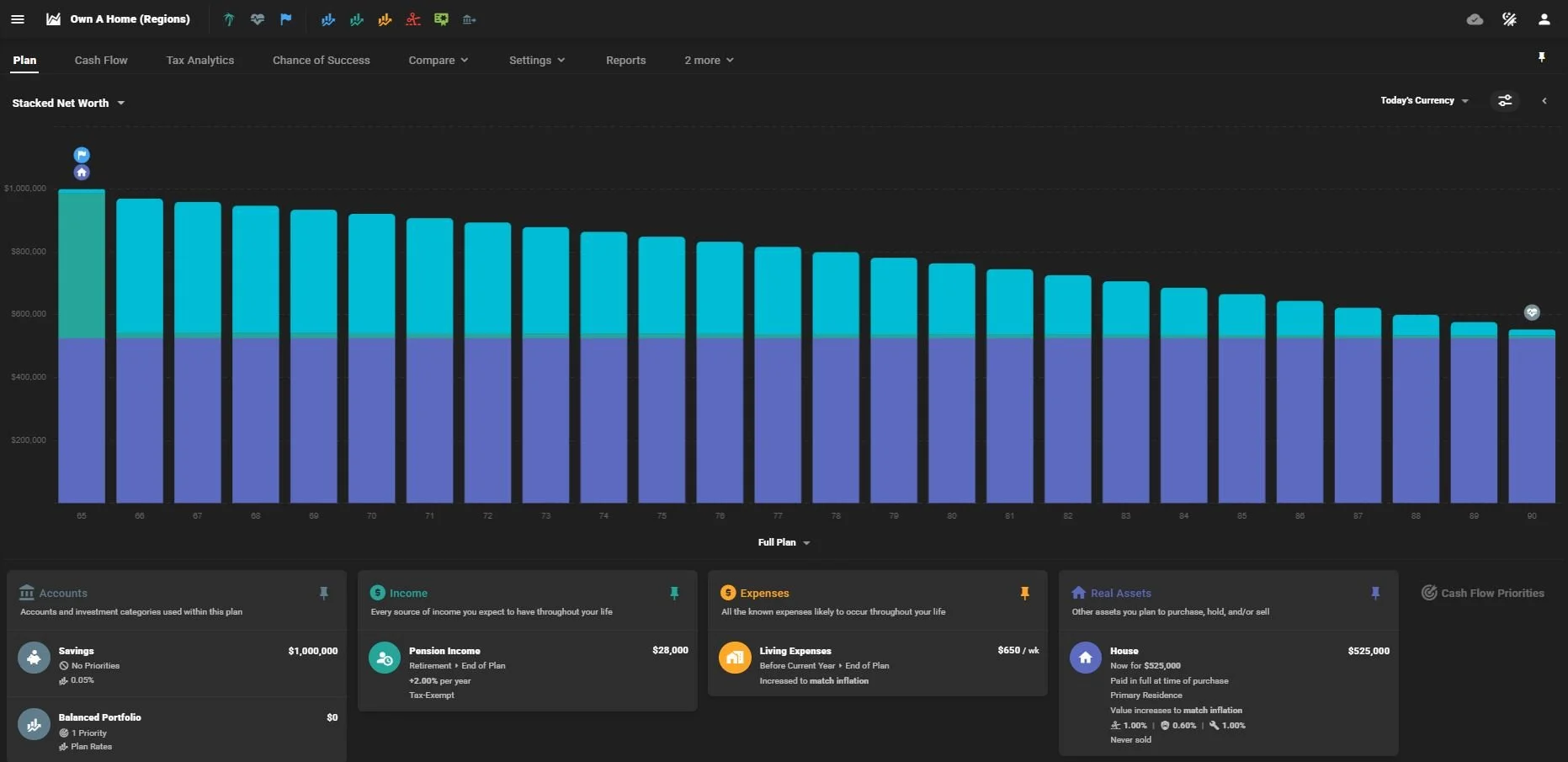
Here the retiree buys a lower cost home ($525,000), preserving $475,000 invested to support lifestyle. The main advantage isn’t just “cheaper housing” - it’s flexibility: more liquid investments means more buffer for health costs, travel, car replacement, and surprises, without needing to sell the home later under pressure or accessing a reverse equity mortgage.
This scenario is the “same idea, better structure.”
You still get the benefit of owning:
less rent risk
greater housing stability
a home that matches inflation long term
But you keep far more liquidity:
You have meaningful investments left to fund your lifestyle
You can absorb health costs, vehicle replacement, and surprise expenses
Your plan has flexibility, not just survival
This is the piece most people miss:
Downsizing is not just cheaper housing - it is buying back optionality.
Optionality means:
you can fund care if you need it
you can travel while you’re able
you can replace things without fear
you can help family without sacrificing your own security
Key risks (Buying cheaper)
Lifestyle trade-off: you may be away from friends, family, and medical networks (importantly, most I’ve observed make this choice do end up moving back within 5 years to be closer to family being worse off real estate fees and moving costs)
Access to services: some regions have weaker health and support infrastructure
Emotional cost: the “cheaper home” has to still feel like a good life, not a compromise you resent
Retirement Village ($600,000) & Live off Remainder ($400,000)
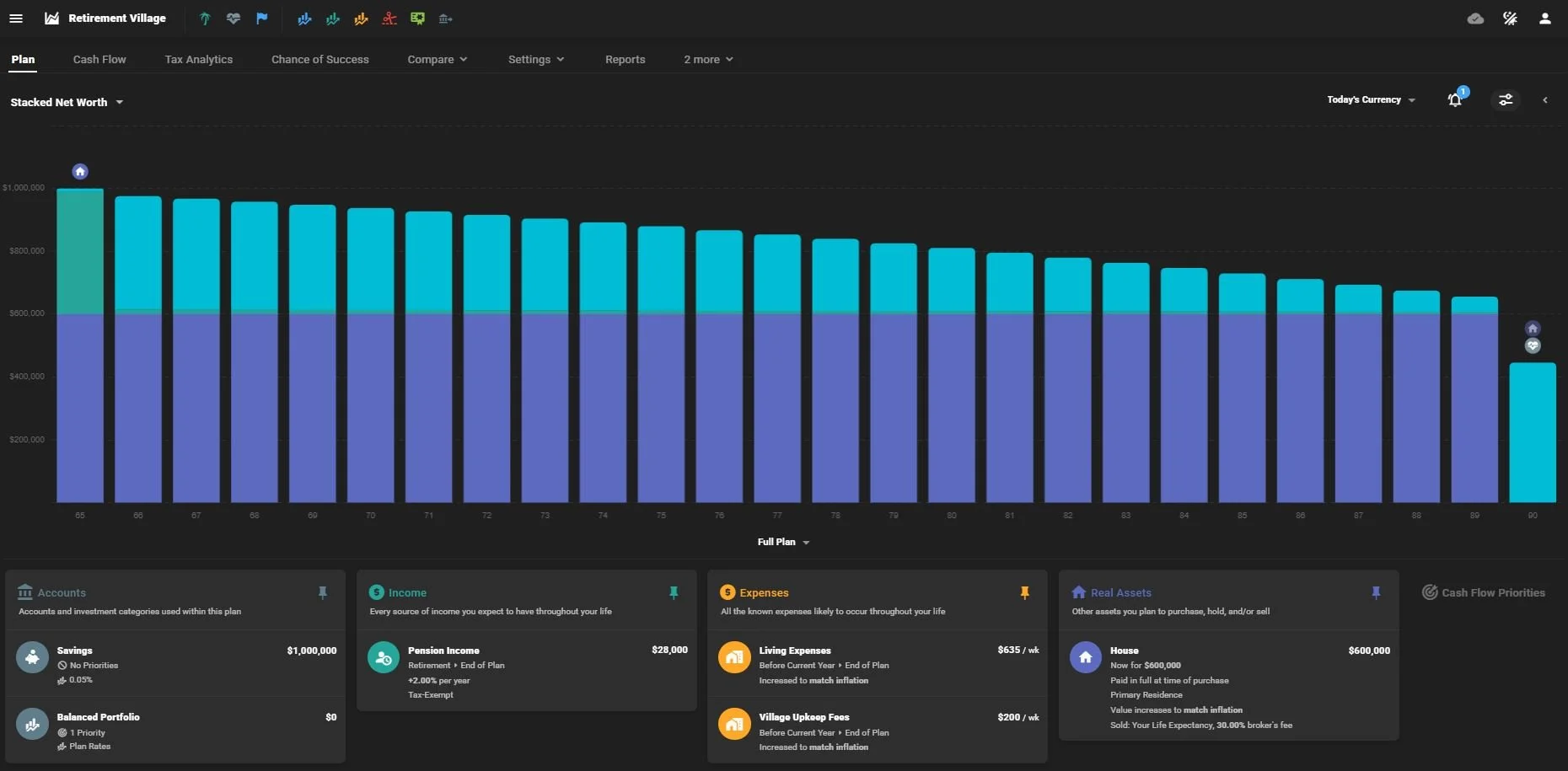
This scenario pays $600,000 for a retirement village licence to occupy and keeps $400,000 invested for lifestyle spending. Ongoing village fees behave like a form of rent, and the long-term result depends heavily on the contract - fees, escalation, and how much capital is returned when you exit.
Retirement villages sit between renting and owning.
You pay a large upfront amount to secure a licence to occupy, then you pay ongoing village fees that resemble a reduced form of rent.
Financially, there are three moving parts:
The upfront capital amount
In this scenario, $600,000 is allocated to the village.The ongoing fees
Here the village upkeep is included as a regular expense - these fees can rise, and they are not optional.What happens when you leave
This is the part people often ignore.
Depending on the contract, the amount returned to your estate can be reduced by:
deferred management fees (25-30% of the value of the property)
time delays in repayment which occurs when they can’t find another buyer
refurbishment costs
resale costs
So the village can work well if:
you value support, community, and lower personal maintenance burden
you are comfortable with the fee structure
your family understands what the estate outcome is likely to be
But it can be detrimental if:
fees rise faster than expected
you need care that is more expensive than anticipated
the exit value is materially less than people assume
Key risks of retirement villages
Contract structure risk: what you get back can be far less than what you pay in
Note: this is especially important if you leave for another retirement village or external care center where you may pay the Deferred Maintenance Fee and perhaps be unable to afford to buy back in another center.
Fee escalation risk: weekly fees can rise faster than CPI
Care escalation risk: health changes can increase costs sharply later in life
Liquidity risk: you have $400,000 to fund lifestyle, but that pool must last and also cover unexpected health events
So what’s the actual takeaway?
It’s not that renting is bad or owning is good.
It’s that each housing option is a different cashflow system.
Renting:
Maximum liquidity
Maximum exposure to rent inflation
Housing remains a permanent annual cost
Housing may become unreliable in the long term as you may need to move a number of times
Owning:
Minimum rent risk
Higher stability
But there’s a risk of being asset rich and cash poor
Owning cheaper:
Keeps stability and reduces rent risk
Preserves the liquidity that funds lifestyle
Often the strongest “balance” outcome if the lifestyle works
Retirement village:
Lifestyle and support benefits
Ongoing fee structure plus contract complexity
Outcome depends heavily on the fine print
The best retirement plan is the one that still works when life gets messy
Most retirees don’t fail because the plan was wrong on day one.
They fail because something changes:
rent rises faster than expected
markets have a bad early decade
health declines
a partner dies
care becomes necessary
the home needs major repairs at the wrong time
The goal is not the prettiest chart.
The goal is resilience - and a lifestyle you can actually live with.